
All articles
Healthcare Turns to AI to Cut Administrative Costs and Unlock Faster Claims Decisions
Fernando Schwartz, PhD, SVP and Chief AI Officer at Claritev, explains why healthcare's complexity has resisted decades of digitization and where AI can finally make a dent.
Make Benefits Brief News one of your go-to sources on Google

Between 15 to 25% of the cost of health care is because people can't agree on what to do. That administrative burden is bureaucracy, and any chip at that is going to be huge for the system and for patients.

Fernando Schwartz, PhD
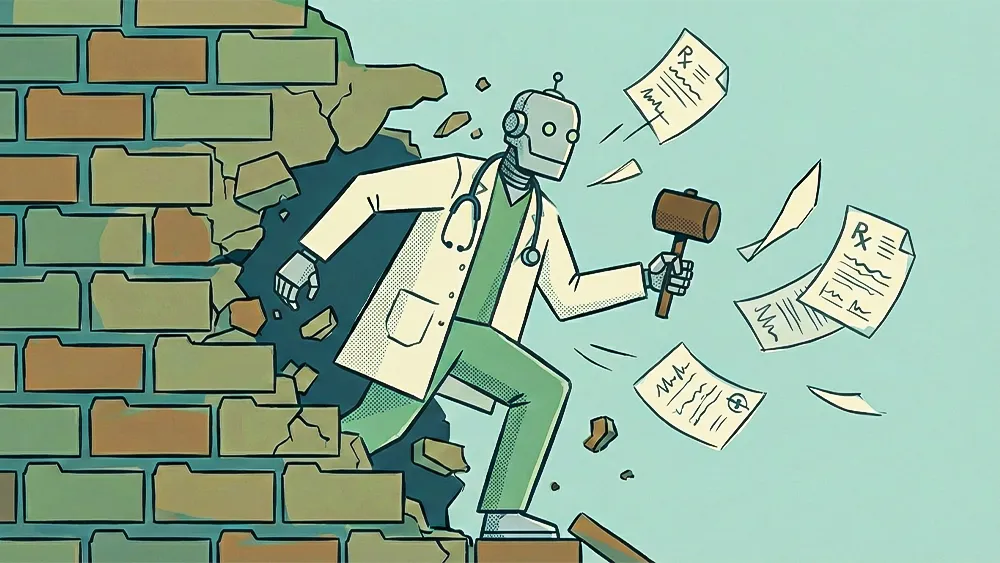
Healthcare's biggest cost problem is not care delivery. It is the administrative machinery that sits between payers, providers, and patients. Bureaucracy consumes 15% to 25% of every healthcare dollar, a tax on the system that has proven stubbornly resistant to decades of technology investment.
Fernando Schwartz, PhD, is the SVP and Chief AI Officer at Claritev, a healthcare technology company focused on data-driven payment integrity and healthcare transparency. A former tenured mathematics professor with AI leadership experience at ADP, Merck, and CitiusTech, Schwartz brings both academic rigor and enterprise-scale deployment experience to the problem.
"Between 15 to 25% of the cost of health care is because people can't agree on what to do. That administrative burden is bureaucracy, and any chip at that is going to be huge for the system and for patients," says Schwartz. The reason healthcare has lagged other industries, he argues, comes down to structural complexity. Advertising technology scaled because it solved a one-to-many problem. Payments scaled because it solved one-to-one. Healthcare requires many-to-many coordination across payers, providers, and patients, a level of complexity that existing technology was not built to handle.
Where AI is working now: Schwartz says the low-hanging fruit is high-volume manual work where speed matters. "There are a ton of negotiations centered around doing things in a timely manner. There's a lot of revenue leakage because we can't get the information in time." His team uses AI to accelerate information gathering for claims processing, a task that previously required large teams assembling data under deadline pressure. Similar approaches are gaining traction across health systems focused on reducing billing errors and documentation gaps.
Measuring what matters: The first metric Schwartz watches is utilization. "If people are using it, you can say it must be doing a good job. If it's not being used, then clearly it isn't working." From there, his team tracks whether highly manual processes are being replaced by faster alternatives, supported by ongoing accuracy evaluations.
Schwartz's team uses a five-pillar assessment framework covering safety, security, privacy, accuracy, and legal exposure. Each initiative is scored on inherent risk, mitigation strategy, and residual risk before moving forward. "The question becomes, is the reward worth the risk?" notes Schwartz.
The AI gateway: A key piece of infrastructure is a centralized AI gateway that routes all prompts to external models. "We have a kill switch. If something were to happen, we can shut down the gateway." The gateway also scans payloads, filters sensitive information, and enforces guardrails. External-facing applications get far more scrutiny than internal tools. "We don't want to be in the newspaper for the wrong reason."
The next frontier, Schwartz believes, is neuro-symbolic AI, sometimes called automated reasoning. The concept combines generative models with deterministic rule-checking software that can verify whether outputs comply with regulations. In healthcare, where clear rules exist but agreement breaks down, this approach could unlock automation in areas like prior authorization that have resisted previous efforts.
Why rules-based verification matters: "In a regulated environment where you need 100% certainty that rules are followed, you have this technology now coming up. You will see the hyperscalers starting to deploy this," Schwartz explains. The application is straightforward: AI generates an answer, then a separate system checks whether that answer satisfies the relevant constraints. For prior authorization, where physicians report spending hours per week on paperwork, the potential impact is significant.
But none of it works without the right foundation. Schwartz says his first priority after joining Claritev was modernizing the tech stack, including a full migration to cloud infrastructure. "Organizations in health care for 2026 should have clear plans to modernize their tech stack. Lay the groundwork so that you can deploy all this wonderful technology to make it worthwhile."
For Schwartz, the goal is personal. "If I could set my aim to something, I would get rid of the bureaucracy in health care and save everyone, the system and the patients, 15 to 25% of the cost. That's the big rock I want to break apart with technology," he concludes.





.png)