
All articles
How Employers Use AI Signals To Prevent Mental Health Crises Before They Escalate
Employees have access to more diverse benefits than ever, but the volume of choices can be overwhelming. Stephen Sokoler, Founder and CEO of Journey, explains how AI can solve this paradox by guiding people to the right care and making the experience more human.
Make Benefits Brief News one of your go-to sources on Google

AI can, in a very simple and elegant way, help people find the right care.

Stephen Sokoler
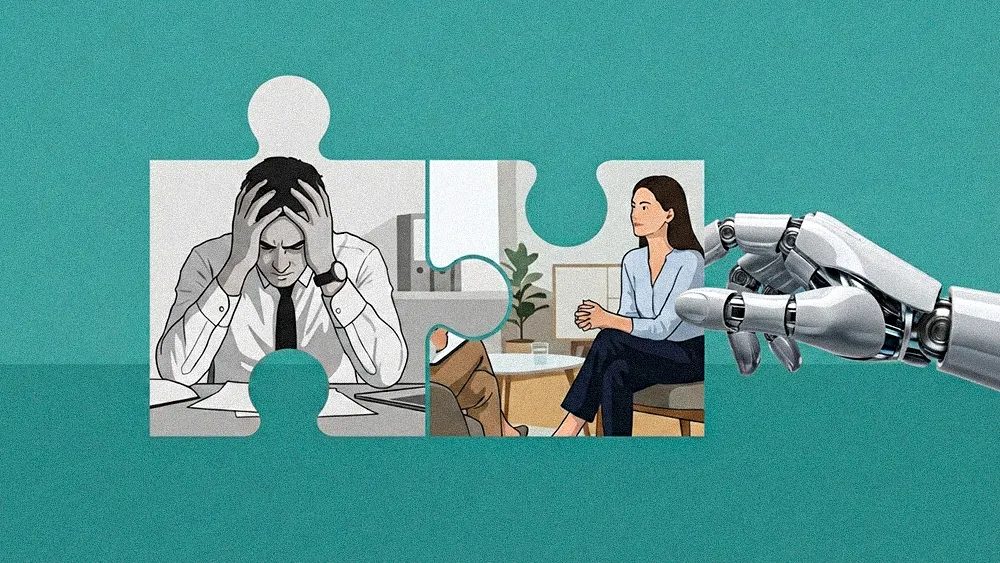
Artificial intelligence is changing how companies approach employee well-being, making mental health support more proactive, accurate, and accessible. As workplace benefits themselves evolve, technology is augmenting the human side of care to help meet the growing need for timely and effective support.
Stephen Sokoler is an expert working on the front lines of this new approach to mental health. As the Founder and CEO of corporate mental health solution Journey and author of The Mental Health Advantage, Sokoler is focused on helping organizations leverage technology to empower employees, reduce turnover, and tackle burnout. He says AI's machine precision can make the difference between an employee getting the care they need and going untreated.
"AI can, in a very simple and elegant way, help people find the right care." AI's ability to closely match a patient's needs with a relevant physician is just one example. "If you don't find the right therapist for somebody, not only will they not get the care that they need, they may swear off therapy forever. AI can help make that matching process more precise, more accurate, and actually more human.”
Paradox of choice: According to Sokoler, one of the biggest barriers to mental health support is actually choice itself. "One thing I hear all the time from HR leaders is that they're putting out this beautiful buffet, this beautiful smorgasbord of amazing benefits to employees, and the employees are coming to them and saying, 'I'm starving.'"
Navigating the maze: With so many options, many of which overlap, Sokoler says employees often don't know where to start. "The bigger the company, the more benefits you have. For mental health, do you go to your healthcare plan, your EAP, or some other point solution?" This is where he says AI's power to guide employees becomes invaluable.
Rather than replace human clinicians, Journey’s tools work on the back end of care to augment human capabilities. Regular employee touchpoints keep mental health top of mind and help employers overcome the common challenge of delayed care. “We don't often ask for help until it's too late,” Sokoler says. “We wait, we delay getting care, and we think things will just naturally get better. What ends up happening is we suffer in silence and things actually get worse.”
Journey recently completed a two-year study demonstrating the impact of early intervention. Identifying at-risk employees sooner and proactively guiding them to care prevented escalation into crisis, avoiding an average of 17 high-cost clinical visits and saving nearly $5,000 per at-risk employee.
By analyzing de-identified conversational trends, usage patterns, and contextual life events, AI can surface moments when proactive outreach may be helpful while maintaining strict privacy boundaries. "For example, if you're in an area that gets hit by a natural disaster, or your number of dependents has gone up or has gone down, or your role changes, there are certain times when being proactive and reaching out is very helpful."
Enhance, not replace: While the potential application of AI in mental health is immense, Sokoler cautions leaders against conflating back-end augmentation with front-end replacement. "The tools are not replacing a therapist," he asserts. "I have concerns in terms of tools that are directly interacting with employees as 'therapists' or 'coaches.' I'm sure the technology will get there at some point, but it's definitely not there as of right now."
Dig for details: For benefits and HR leaders exploring AI solutions, he recommends a rigorous, hands-on approach. "There's a lot of snake oil out there, so the advice I have for leaders is to ask lots of questions. Dig, dig, dig, and do lots of testing. Don't just listen to what a company claims to be doing. Actually go and use it, experience it, and ask lots of probing questions."
Looking ahead, Sokoler expects the trend of building AI into existing platforms will only accelerate. He sees the market splitting into two distinct paths, with established players making incremental improvements while a new generation of startups aims for disruption. “The companies that win won’t be the ones with the flashiest AI. They’ll be the ones that use it responsibly to help people get care earlier and more effectively.”





.png)